Showing posts with label Juliette Binoche. Show all posts

Friday, May 27, 2011

DeLillo and Baudrillard On Rothko

Rothko


Rothko


Baudrillard:

"Rothko says that his pictures have two characteristics: either they dilate and then open up in all directions, or they contract and then close up precipitately on all sides. Between these two poles lies everything he has to say.

Rothko's change, his passage almost without transition, to an immediate, definitive form. It is there all at once, perfectly mastered, end of story. And it is light-years away from what he was doing up to that point.

This is something entirely different from an evolution - even a creative evolution. It is an almost genetic impulse by which he separates himself miraculously from the artist he still was, with his place in the history of art, to be nothing but the sovereign medium of an extremely simple form, which no longer has anything to do with expressionism or abstraction." (Cool Memories IV 84-85)

The emergent form stuns you with its simplicity. And perhaps the most surprising thing is that, during our earthly existence, in which our brains are bound with bands of steel - the tightly-fitting dream of our own personality - we did not by chance give that little shake which would have freed the imprisoned thought and procured for it the ultimate understanding.(Nabokov)

"Does not everyone have within them this potential mutation, this potential development? This absolute singularity which asks only to be effortlessly produced" (CM IV 85) - an transpired form that has sloughed off our individual yoke?

Didi Fancher: I think you want this Rothko. Pricey. But yes. You totally need to have it.

Eric: Why?

Didi: It will remind you that you're alive. You have  something in you that's receptive to the mysteries.

Eric: The mysteries?

Didi: Don't you see yourself in every picture you love? You feel a radiance wash through you. It's something you can't analyze or speak about clearly. ... But it makes you feel alive in the world. It tells you you're here. And yes, you have a range of being that's deeper and sweeter than you knew.(C 30)
___________________________________________________________________
If you look awhile at a Rothko and then look at a white wall, you will see a negative after-image. An inversion of color, so I have left white beside these images so you can do it.  Then when you see a real one, try it.

Other Rothko blog of mine

Tuesday, April 26, 2011

The Rothko Chapel That Eric Packer Wants to Buy


The Rothko Chapel was the last and one of the most important endeavors that Dominique and John de Menil, its founders, worked on together. This modern work of religious art commissioned for Houston is comparable in importance to the Chapel of the Rosary in Vence by Henri Matisse or le Corbusier's Chapel in Ronchamp, France.

Eric Packer wants the entire chapel and Didi Fancher tells him he cannot have it.
The Chapel is the culmination of six years of Rothko’s life and represents his gradually growing concern for the transcendent. For some, to witness these paintings is to submit one’s self to a spiritual experience, which, through its transcendence of subject matter, approximates that of consciousness itself. It forces one to approach the limits of experience and awakens one to the awareness of one’s own existence. For others, the Chapel houses 14 large paintings whose dark, nearly impenetrable surfaces represent hermeticism and contemplation. http://tinyurl.com/6jy4es2


Marc Schuster in his book DON DeLILLO, JEAN BAUDRILLARD AND THE CONSUMER CONUNDRUM
discusses this kind of excessive consumption as signs that indicate the power and wealth of an individual. The de Menils' established a foundation to enable others to view and experience these paintings within a spiritual setting. Eric Packer wants the entire chapel for himself only. The crassness of this is what irritates Didi Fancher.


Philadelphia.  The New Barnes Collection Opens.  The controversial and infamous Barnes Foundation enters its next incarnation in life in center city Philadelphia.  If you don’t know what the Barnes Foundation is, it’s an extraordinary world renowned art collection put together by the now deceased Albert Barnes.  Up until now, due to strict provision in his will, visitors had to travel to Barnes’ former home outside of the city in order to see the collection, but a series of highly controversial court decisions changed all that, and the collection has been moved to a brand new museum in center city Philadelphia, that was designed to precisely replicating his home.  It’s a fascinating story and a world-class collection of great paintings, sculpture and other works of art.  The new facility officially opens on Saturday, so you can be among the first to check it out.


This is a tragedy of corruption and greed by the City of Philadelphia. To see the Barnes Collection in its beautiful home in Merion Pennsylvania where Albert Barnes lived with his collection, is to see it as it was meant to be seen. This is the kind of thing Eric Packer wanted to do to the Rothko Chapel collection.


Sunday, April 24, 2011

Reading the Grid in Cosmopolis Through Foucault and Agnes Martin

Agnes Martin Print

On a Clear Day 1, 1973.

Agnes Martin
   Go to the links here for a number of prints including the upper one. Didi Fancher has a grid print on the wall. It may be an Agnes Martin drawing, or a derivative of her work, or one her assistants did it a la Andy Warhol. He pressed her against the wall drawing, a minimalist grid executed over several weeks by two of the artist's adjutants working with measuring instruments and graphite pencils. 


On the right is an Agnes Martin painting. They are usually large, 5 to 6 ft across and almost as long. They are pale and lovely. But they are not dangerous. Or are they?


Eric Packer's Grid
Foucault's Power/Knowledge grid is what Eric Packer is caught in on this last day of his life. H begins it in linear time, historical time, within a dialectical frame. It charts implies time that is linear. Only it doesn't chart because Eric is within a simulated reality. He is trying to go in a straight line from East to West. But he is in global Virtual Reality. Numbers (yen), information, sex all circulate in an orbit.   So are the "rats".


In an interesting article on Richard Serra's minimalist Tilted Arc 1981  and its removal by the courts from its site-specific selected and commissioned place by the GSA at 26 Federal Plaza in Lower Manhattan,  the author says
Richard Serra: Tilted Arc from minimalissimo.com

Minimalist sculpture is a critique of commodification, with its outwardly simplified visual schemas which seem to diminish the uniqueness of these objects.  Their artistic value can be difficult to extract.  In this sense, Minimalism reflects many of the social and political issues addressed by the American counterculture.

The critique continues and of course all this folds in with DeLillo's Cosmopolis in a seamless fashion. An Agnes Martin grid resonates with a Foucauldian grid of power/knowledge/capital and this grid was exactly what got Tilted Arc removed from its site after  an almost 10 year court battle. NOt to mention the GRID of traffic Eric Packer is moving in quarter inches all day.

Sunday, April 17, 2011

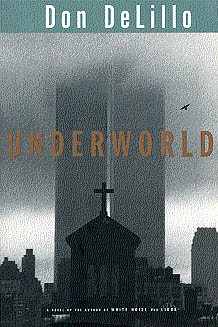
Reading Cosmopolis Through DeLillo's Clairvoyant Underworld Book Cover

Cover Art Chosen by DeLillo
The cover of the first edition of DeLillo's 1997 Underworld. DeLillo himself chose the image for it. Scary huh?  That's not an airplane up there but it sure looks like one now that we know the future context and perceive the image with hindsight. Actually it is a bird. A bird, a gull maybe, like the one Eric Packer sees into that dawn of his last day alive.


August 1974 Philippe Petit walks a tightrope between the Twin Towers.


Man On Wire youtube


slideshow:


http://www.youtube.com/watch?v=6ddpV1GvF7E&NR     can paste in browser

Now approaching the 10 year anniversary of the loss of the twin towers, Petit says, .... and that are now gone. Interviewed recently for his one-man show of his life story, Petit said that the towers still exist -- in his mind. "I don't see time begin and end. In my head, the twin towers are still alive.... On the subject of the towers disappearing, of course it was an immense -- sadness is not the word -- it was something alive that was pulled out of me," he said. Years after the attack, he holds onto that 1974 memory. "Nothing can change that. The memory of this adventure is an intimate, romantic, poetic, joyful feeling that will continue...for the rest of my life." LINK


Dan Goodwin Climbing Millennium Tower 


Spider Dan has climbed an amazing list of towers:
The list of towers "Spider Dan" has climbed before reads like an encyclopaedia of famous American towers. Starting off with the Sears Tower, Chicago in 1981, he has also conquered the World TradeCentre (North Tower) New York, the CN tower in Toronto and the Hancock Centre, also in Chicago. 

These buildings are seductive.  And seduction is coupled with challenge. Always. Just like mountains, like Everest. They are objects beckoning the subject. They were Strange Attractors from Baudrillardian theory. Just as particles in a particle accelerator with opposite charges seek each other, play with each other, and when they collide....pouf!


These are beautiful films but the suggestiveness of the Twin Towers is inescapable. Add the bomb and explosion in 1992 and it seems incomprehensible our government did not perceive the seductiveness of the Twin Towers.


Vija: "You live in a tower that soars to heaven and goes unpunished by God."
She found this amusing.
"And you bought an airplane. I'd nearly forgotten this. Soviet or ex-Soviet. A strategic bomber. Capable of knocking out a small city. Is this right?" (C 103)


Baudrillard might say that the World is thinking this 9-11 Event that's coming.


Collapse of Twin Towers
It is probable that the terrorists had not foreseen the collapse of the Twin Towers (any more than had the experts!), a collapse which - much more than the attack on the Pentagon - had the greatest symbolic impact. The symbolic collapse of a whole system came about by an unpredictable complicity, as though the towers, by collapsing on their own, by committing suicide, had joined in to round off the event. In a sense, the entire system, by its internal fragility, lent the initial actions a helping hand. ( The Spirit of Terrorism 8)


Baudrillard- The Spirit of Terrorism


But governments lie within the order of production not seduction. The meaning of the Event of 9-11 lies in its secret. The 24/7 media coverage of circulating information drowned us in bits, but information is not knowledge. It is not knowing. The circulating bits of information reveal and conceal the meaning of any Event.  The media circulating information becomes the Event. The secret of 9-11 is that governments are powerless to stop terrorism except to put the domestic population under more and more surveillance to create the empty sign of a security it cannot provide.


What does this have to do with Cosmopolis?

Saturday, April 16, 2011

Reading Cosmopolis Through Spencer Tunick's Performance Art

Mexico City


Spencer Tunick's Performance Art Piece This is huge and spectacular. See all the rest of his performances with nude/naked bodies while you are there. Very beautiful.

A slideshow that is spectacular:

And another one:


Down on left perhaps London. I don't think it is New York so tell me if you know.


And of course the last one is from the Concentration Camps just after liberation and too late for many.  The image taken with film cries out in a way the posed bodies do not, (digital?) but then the context is deathly, the bodies starved.
London?
I am wandering within McLuhan's  thought about the medium is the message. What if these images were presented differently. Some large, some very small. Would the message be different? Say the Camp bodies huge, the performance bodies small or the reverse? What about the order? If I included or you imagined the bodies in Haiti, or Afghnistan, or Tsunami, or Bosnia victims piled up, would that affect your perception of these images. If you have read the scene these refer to in Cosmopolis, does that change your perception?

De Lillo of course is self-referencing White Noise when the students are preparing for a rehearsal for an imagined catastrophe, lying down fully dressed, some in official helping roles. During War II we used to have air raid drills, hiding under our desks. The same during A bomb cold war time children rehearsed along with their teachers. A kind of higher level fire drill.
Liberation of a Camp

Monday, March 21, 2011

DON DeLILLO, JEAN BAUDRILLARD AND THE CONSUMER CONUNDRUM-MARC SCHUSTER

Marc Shuster's Wonderful Analysis
Many critics have identified the affinities between French theorist Jean Baudrillard and American author Don DeLillo;however, this is the first detailed and sustained comparison between DeLillo's novels and Baudrillard's works. .....This thorough and thoughtful reading of both writers not only acknowledges their affinities but also exhaustively explores the ways in which their writings inform and illuminate each other. By examining DeLillo's novels within Baudrillard's theoretical framework, Marc Schuster has provided a rich critical milieu in which an informed reading of both writers' works may take place. A wealth of insights is offered to both the new reader and the established fan. DeLillo is a major force in American literature and, as a consequence, a collection like this, with allusions ranging from T.S. Eliot to Slavoj Zizek, will prove invaluable to scholars of all levels. Similarly, Baudrillard's place on reading lists, especially for critical theory courses, is guaranteed, making this book crucial reading for those with an academic or general interest.(Foreword ix-x)


This blog will extend Schuster's original contribution into other areas of Baudrillardian theory as it relates to DeLillo's Cosmopolis and to Cronenberg's film Cosmopolis starring Rob Pattinson, Paul Giametti, Juliette Binoche and Samantha Morton.

Since I am reading Cosmopolis very differently from all other reviews, including Schuster's, I read Eric Packer from the POV of a visionary hero rather than a billionaire, estranged from himself and everyone else who loses his fortune in one day. I am saying that he does not lose it but deliberately disappears it, vanishes it, in order to implode the system, as Baudrillard has suggested in his later work.